Showing posts with label section40. Show all posts

Flap motor secured

Very short post - after figuring out the heat tee servo installation, I secured the flap motor and its wires for good:

Flap motor secured in place inside the tunnel

With this, section 40 is complete.

Time lapse:


Total flap system time: 21.0h

Flap system done

With the last bit of section 26 out of the way, I completed section 40 by actually installing the flap motor. This required some trimming of the angles so the motor doesn't interfere with them when it moves:

PH flap motor brackets put together temporarily

A test run of the motor showed only minor adjustment needed to the rod end, and it was exciting to see something moving in the plane:


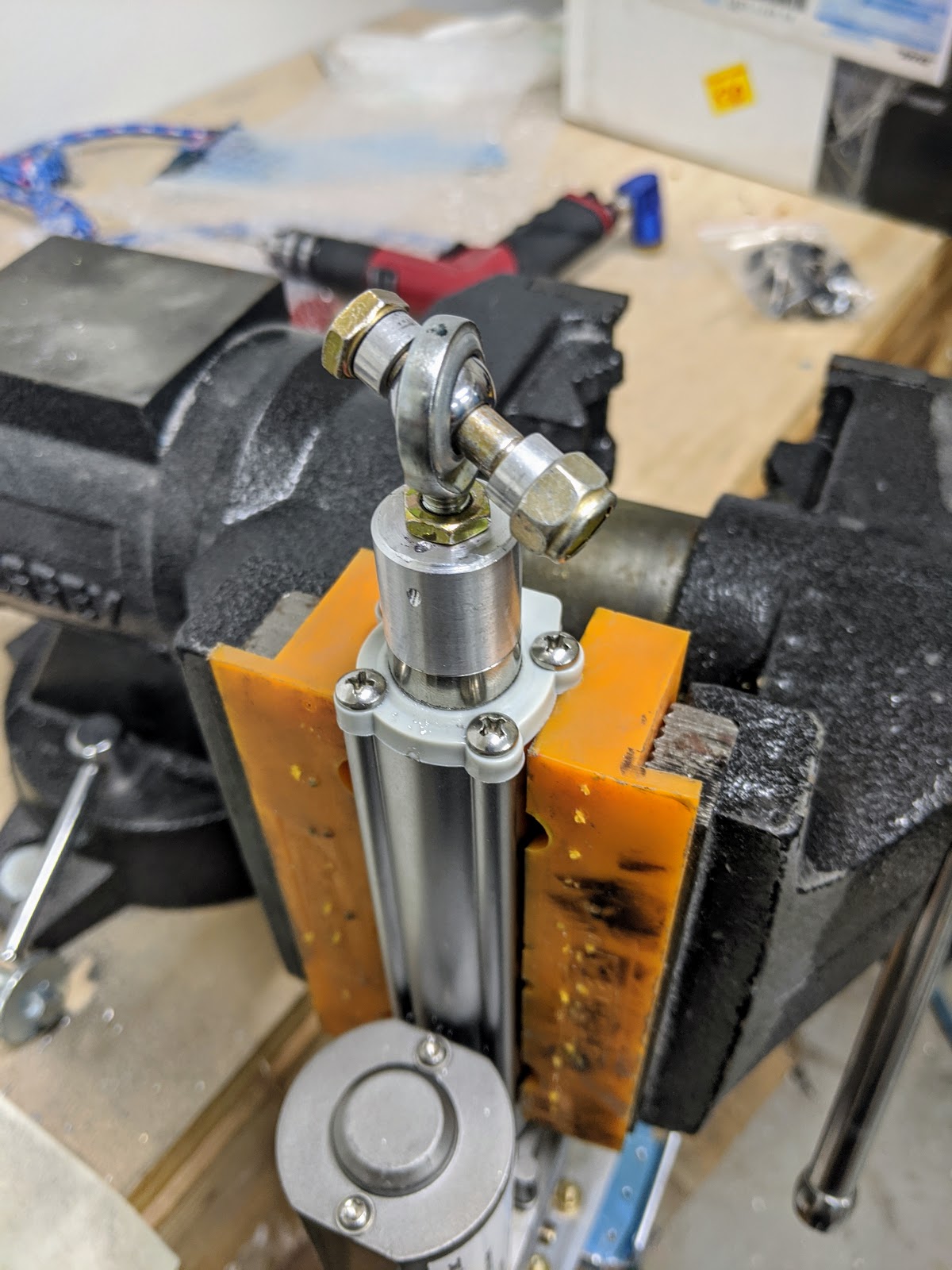
I made the spacers for attaching the motor rod end, and drilled the safety-wire hole at its tip (not strictly necessary since the tip doesn't try to rotate/disengage the bearing like the stock motor does, but it's added safety anyway):

Spacers for attaching motor rod end
Safety wire hole drilled through actuator head

Actuator head with attachment hardware


Finally, I picked the proper spacers from aluminumspacers.com for the motor - I ordered pairs of a few different sizes, but ended up using the 5/16" ID / 1/2" OD / 15/32" long ones:

Spacers for attaching motor

With this, I'm now going to sell the original flap motor (any takers?):

Stock vs PH flap motor

To actually install the flap motor, I also had to secure the TAS cable around it, which I started by running the cable to check its path:

Running TAS antenna cable near flap torque tube

TAS antenna cable running through tunnel around flap motor area

TAS antenna cable reaching antenna, with connectors in position

This was not good enough to understand the cable bends and overall path, so I actually crimped one of the connectors to it:
Stripped RG-400 for QMA connector

Crimped QMA connector

Inner QMA connector conductor, which needs to be soldered

Using that one cable (and the other 3 connectors) to see a realistic cable path, we installed the Clickbond fasteners along the cable's route, and checked that it won't interfere with the pushrod:

Clickbond fasteners installed in place for TAS antenna cables

TAS antenna cable temporarily secured to Clickbond fasteners around tunnel

TAS antenna cable temporarily secured and connected to antenna underneath pushrod

TAS antenna cable connected to antenna underneath pushrod

TAS antenna cable connected to antenna's far-end connector

TAS antenna cable secured to avoid flap crank

We were also wondering if it was ok to mount the control systems and flap motor at this time and still be able to install the antenna later, so we tried a mock install - turns out we can pass the cables out the hole, connect 3 of the 4 to the antenna and still get it back in place, with the last one being the only one that has to be connected through a tiny space around the flap motor and pushrod:

4 TAS antenna cables running through tunnel

Checking if the TAS antenna connectors can be secured from the outside

With this, after completing a large chunk of section 39, I finally installed the flap motor, mostly completing this section:

Flap motor installed in place

I'm leaving the final torquing of those last bolts, the safety wire and running the motor cable for later just in case I need to remove the motor to attach anything else in this busy section of the tunnel.

Time lapse:


Total flap system rivets: 0
Total flap system time: 20.2h

Large batch of fuselage primer

We primed quite a few parts from various fuselage sections (and even some from the empennage attachment, and for rebuilding part of the vertical stabilizer):

Various fuselage parts after scrubbing with Prekote

Primed fuselage parts on the floor (ran out of space elsewhere)

Primed fuselage parts on the workbench

Primed fuselage parts on top of the fuselage

This unblocks a ton of work, so expect many more posts in the near future.

Time lapse:


Total time: 6.5h (but I'll count it towards each section instead)

Flap system started

I started working on the flap system, which is mostly the torque tubes and crank that connect the motor to the wings.

This starts by setting the torque tubes and horns in very specific angles/distances and match-drilling for bolts:

Flap horn, torque tube and crank in position for drilling

Drilled and bolted flap torque tube, horn and crank


Both torque tubes and horns drilled and bolted to the crank

These tubes are mounted into delrin blocks for alignment, so those had to be trimmed:

Delrin bushing blocks marked for trimming

Trimmed torque tube bushings

After priming the tubes, we installed them, which was actually quite a bit more work than expected given how tightly everything fits together (and the layer of primer doesn't help there):

Installed flap torque tubes, bushings and crank

Torque tube to horn attachment bolts, in a tight area

Horn, torque tubes, bushing and crank

With this, the only step left in section 40 is actually installing the motor, but for that I need to finish figuring out the bracket for the PHA motor (which also involves completing the last few steps of section 26)

Time lapse:


Total flap system rivets: 0
Total flap system time: 14.0h

Primed parts for various sections

We had noticed some rust forming on the steel parts (e.g. for the control system and flap system), so we decided to prime all of those, as well as some other parts that would be helpful (like the floor pans):

Primed bolt access plate, floor pan, idler arm parts, tailcone shims, pushrods, flap torque tubes, landing gear mount and control stick base

Primed floor pan, control sticks, control stick base, flap horns, and step blocks

For a change, I'll include the times and videos with each section for which we did this.